
What CRM3 Means for Canadian Advisors and Their Fee Conversations
A post looking at how CRM3 will change the way fees are disclosed and how advisors can prepare for these conversations
For many clients, CRM3 will not change what they pay. It will change what they see.
That distinction matters. A client who has owned mutual funds or ETFs for years has already been paying embedded fund costs through the value of the fund. But once those costs appear in annual reporting, in dollars, tied to their own account, the conversation may feel new. Advisors who wait for the first statement to arrive may find themselves explaining a number. Advisors who start earlier can frame the discussion around value, portfolio construction, and the client’s financial plan.
From CRM2 to CRM3: what is changing?
Canada’s Client Relationship Model reforms were designed to make the advisor-client relationship more transparent. CRM2 was a major step because it required clearer annual reporting of account performance and the fees or compensation paid to the dealer and advisor. But CRM2 did not fully capture the ongoing costs clients pay indirectly inside investment funds.
CRM3, more formally known as Total Cost Reporting, is meant to close that gap. The issue is not necessarily that clients were paying new fees, but that some ongoing fund costs were embedded in the value of the investment fund and were therefore less visible in annual client reporting.
The CSA and the Canadian Council of Insurance Regulators adopted the Total Cost Reporting Enhancements in April 2023 for investment funds and segregated fund contracts. CIRO’s parallel enhanced cost reporting rule amendments were approved in 2025 and are effective January 1, 2026. CIRO has indicated that the first annual reports incorporating these enhancements are expected for the year ending December 31, 2026. Source: CIRO
The practical change is that annual reports will expand beyond dealer and advisor compensation to include investment fund costs incurred by the client. For in-scope funds, this can include total fund expenses, direct investment fund charges, an aggregate total of fund costs, an aggregate total of fund costs plus dealer/distributor costs, and the fund expense ratio for each fund class or series. Source: CIRO
CRM3 cost stack explainer
What the client may now see more clearly
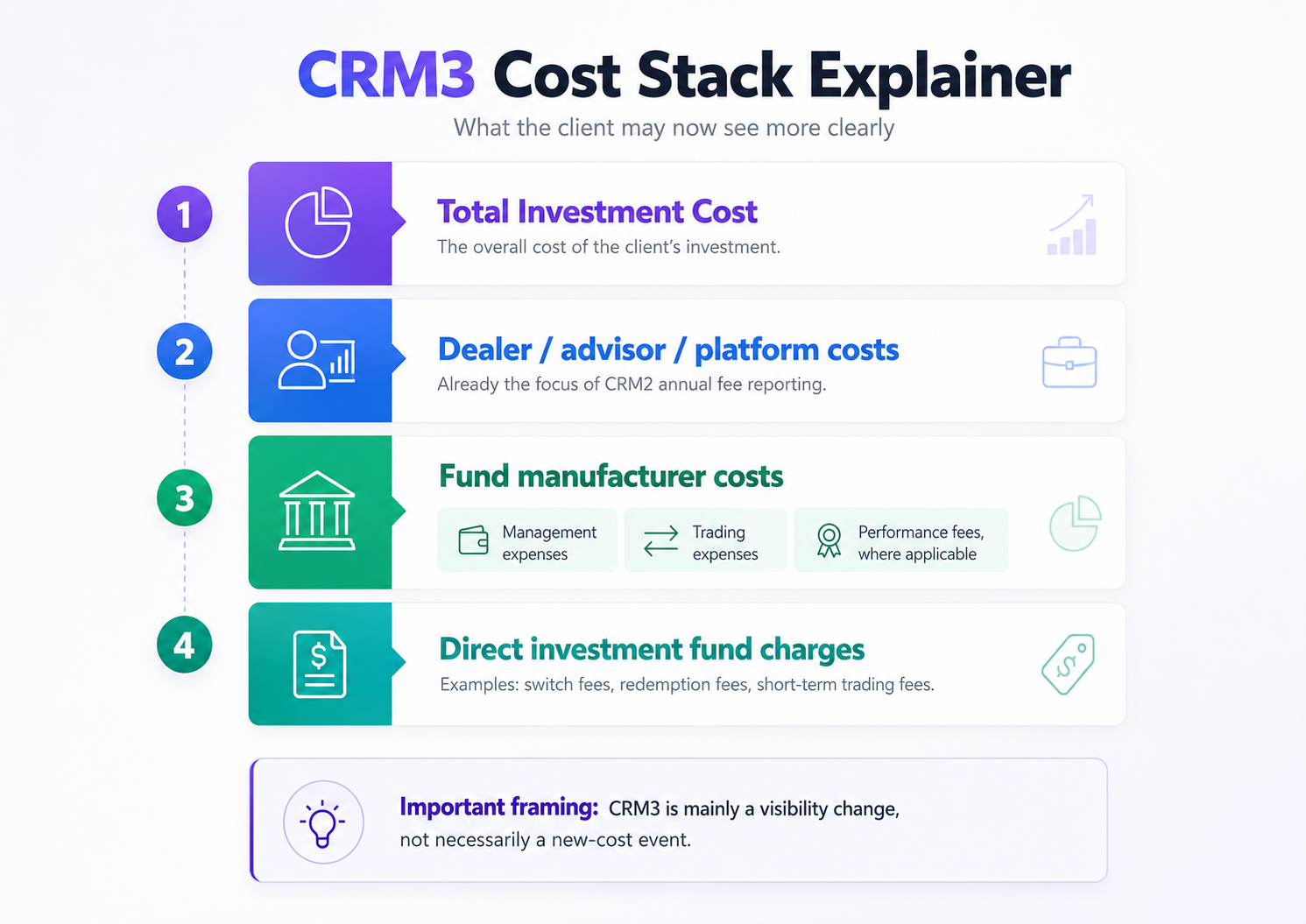
Important framing: CRM3 is mainly a visibility change, not necessarily a new-cost event.
What clients will see
This is where the emotional reaction may come from. Clients are used to seeing account values, performance, transactions, and some fee disclosure. Under CRM3, a client may now see a larger and more complete dollar figure connected to the funds they own.
That can create two predictable questions: “Is this a new fee?” and “Am I paying twice?”
The answer should be clear: in most cases, the embedded fund cost was already being paid through the fund. CRM3 makes it more visible and more personalized. CIRO’s proposed framework distinguishes between fund expenses embedded in the fund value, direct investment fund charges paid when transacting or holding a fund, and dealer operating or transaction charges already reportable under existing rules. Source: CIRO
Before-and-after statement anatomy
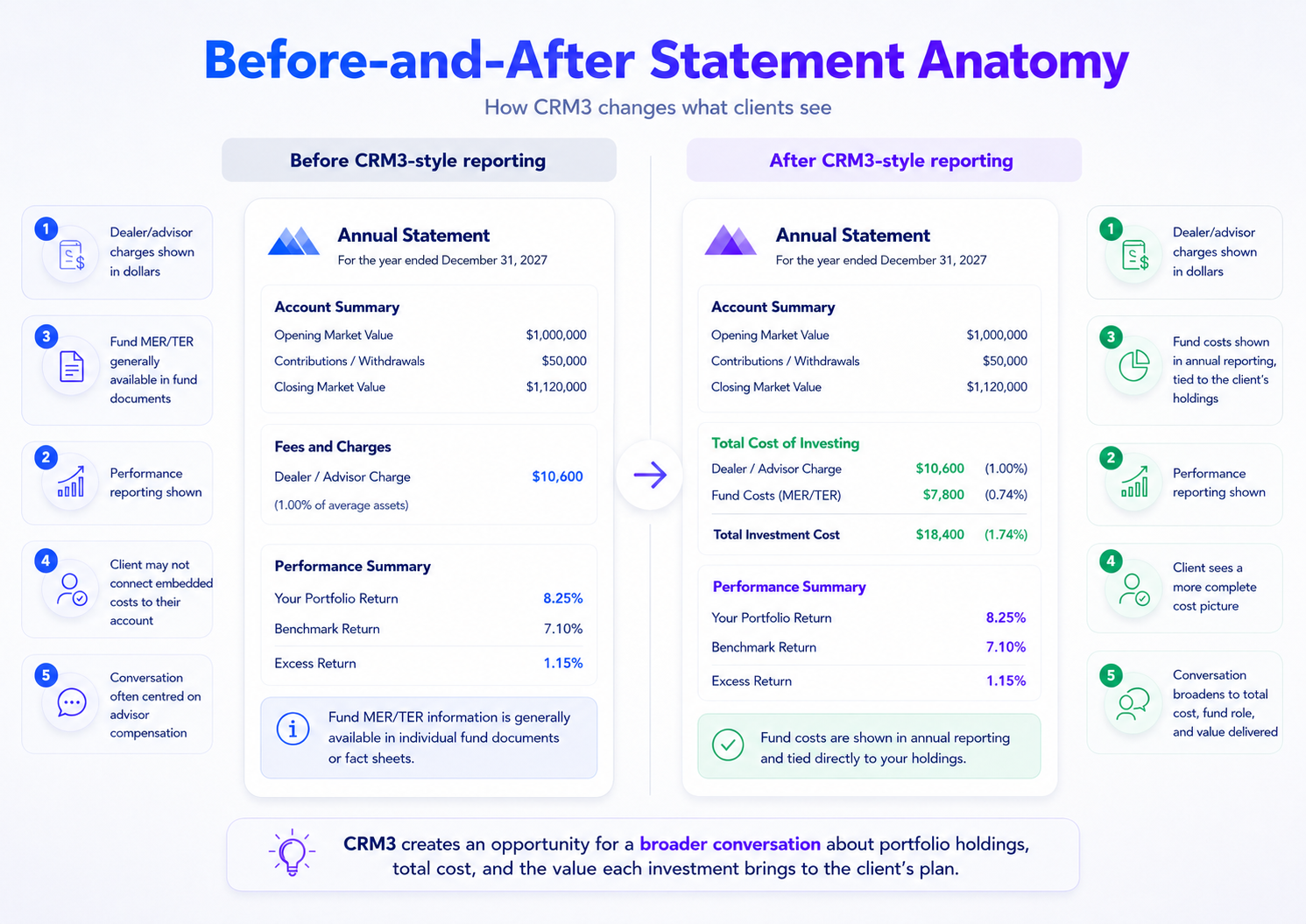
The most important advisor preparation point is that clients should not learn about CRM3 for the first time when they open their annual report.
What the evidence says about disclosure and outcomes
Disclosure is necessary. But disclosure does not automatically create understanding.
Academic research on simplified mutual fund disclosure has found that simpler documents do not always change investor choices. In a NBER experiment, participants who received simplified mutual fund disclosure did not make meaningfully different portfolio choices, and many still failed to avoid sales loads even over a short investment horizon. Source: NBER
Other research suggests disclosure can improve comprehension, but the behavioural impact can be more complicated than regulators or industry participants might expect. A 2022 study of U.S. relationship-summary disclosure found that participants viewed the disclosure as helpful and showed improved comprehension, but the disclosure also affected preferences between account types. Source: arXiv
The lesson for advisors is straightforward: CRM3 may improve transparency, but it will not explain value on its own. The statement can show cost. It cannot explain why a fund is in the portfolio, what role it plays, what risk it manages, or how it connects to the client’s plan. That work still belongs to the advisor.
How advisors can approach the fee conversation
The wrong response to CRM3 is to treat every fee question as a pricing objection. The better response is to bring the conversation back to the client’s goals, the portfolio’s design, and the evidence supporting each recommendation.
Performance matters, but it should not be the only lens. A fund with a higher cost and weaker recent performance may still play a valid role if it provides exposure, diversification, downside management, income characteristics, or risk controls that the rest of the portfolio does not.
A portfolio is not a collection of yesterday’s best performers. It is a tool built to fund retirement income, manage uncertainty, preserve capital, grow purchasing power, or meet a family’s future obligations.
This is especially important with active funds. A fund that looks very similar to its benchmark should be held to a different standard than a fund that is genuinely differentiated. Active share is one way to describe how different a fund’s holdings are from its benchmark; a high active share can indicate that the manager is providing exposure that is not easily replicated by simply buying the index. That does not guarantee outperformance, but it helps frame the right question: is the client paying for something meaningfully different, and is that difference useful in the portfolio? Source: Investopedia
Advisors should also be ready to explain what fund companies are doing to earn their fee. That may include investment teams, analyst coverage, risk management, company meetings, facility visits, industry conferences, proprietary datasets, credit research, trading infrastructure, and portfolio oversight. But this explanation should be specific. “Research” is not enough. The stronger conversation is: “Here is the process. Here is how it differs from the index. Here is the role it plays in your portfolio. Here is how we monitor whether it continues to deserve its place.”
It can also help to translate dollar fees back into percentages. A $3,000 annual cost can feel large in isolation. On a $300,000 account, it is 1%. That does not mean the fee is trivial. It means the client should evaluate it in proportion to the capital being managed and the value being delivered. Clients are already used to percentage-based costs in daily life, from sales taxes to restaurant tips, but investment fees deserve a higher standard because they compound over time. The point is not to minimize the dollar amount. The point is to prevent the dollar amount from overwhelming the broader value discussion.
A useful advisor script might sound like this:
“This report is designed to show the full cost of your investments more clearly. Some of these costs were already embedded in the funds you owned; they are now being shown in a more personalized way. Our job is to make sure every cost is connected to a purpose: your financial plan, the portfolio’s risk management, the type of exposure we want, and the outcomes we are trying to achieve.”
Practical CRM3 checklist for advisors
Start the conversation before the first CRM3-enhanced annual report arrives. Tell clients what is changing, why they may see new line items, and what is not changing.
Identify households most likely to have questions: larger accounts, fund-heavy portfolios, fee-based accounts using F-class funds, clients with recent underperformance, and clients who are especially cost-sensitive.
Build a simple cost inventory for each model or common portfolio. Know the approximate all-in cost, the active/passive mix, which funds have higher fees, and why each one is there.
Review your KYP documentation. If a fund has a higher cost, the file should clearly support why it is suitable, what role it plays, and how it compares with reasonable alternatives.
Prepare a one-page client explainer. Include the difference between advisor/dealer fees, embedded fund expenses, direct fund charges, and total cost. Make it visual.
Train the team on the two most likely questions: “Is this new?” and “Am I paying twice?”
Re-center reviews around the plan. Use performance, but combine it with risk, diversification, income needs, tax considerations, time horizon, liquidity, and behavioral coaching.
Document the conversation. If CRM3 leads to a fund change, fee change, or decision to stay the course, capture the rationale.
A trust-building opportunity
CRM3 is not just a regulatory update. It is a trust test.
Clients will see more. Some will ask better questions. Some will ask harder questions. That is not a threat to advisors who can clearly explain their process, document their recommendations, and connect every investment decision to the client’s plan.
The opportunity is to move the fee conversation from “what did I pay?” to “what am I paying for, why does it matter, and how does it help me reach my goals?”
How Konsyra can help
Konsyra is built to help advisors turn fee transparency into a better portfolio conversation.
- Compare thousands of mutual funds and ETFs across key attributes, including fees, risk, performance, portfolio exposure, and fund characteristics.
- Support existing portfolio positions with clearer KYP documentation, peer comparisons, and rationale for why a fund continues to fit.
- Evaluate new positions by comparing cost, exposure, diversification benefits, and suitability against reasonable alternatives.
- Identify lower-cost options that may offer similar attributes, helping advisors show that cost was reviewed rather than ignored.
- Create a more consistent record of the advisor’s process, so fee conversations can be grounded in evidence, not just opinion.
CRM3 may make costs more visible, but advisors still need to explain value. Konsyra helps organize the data behind that explanation.
Continue reading
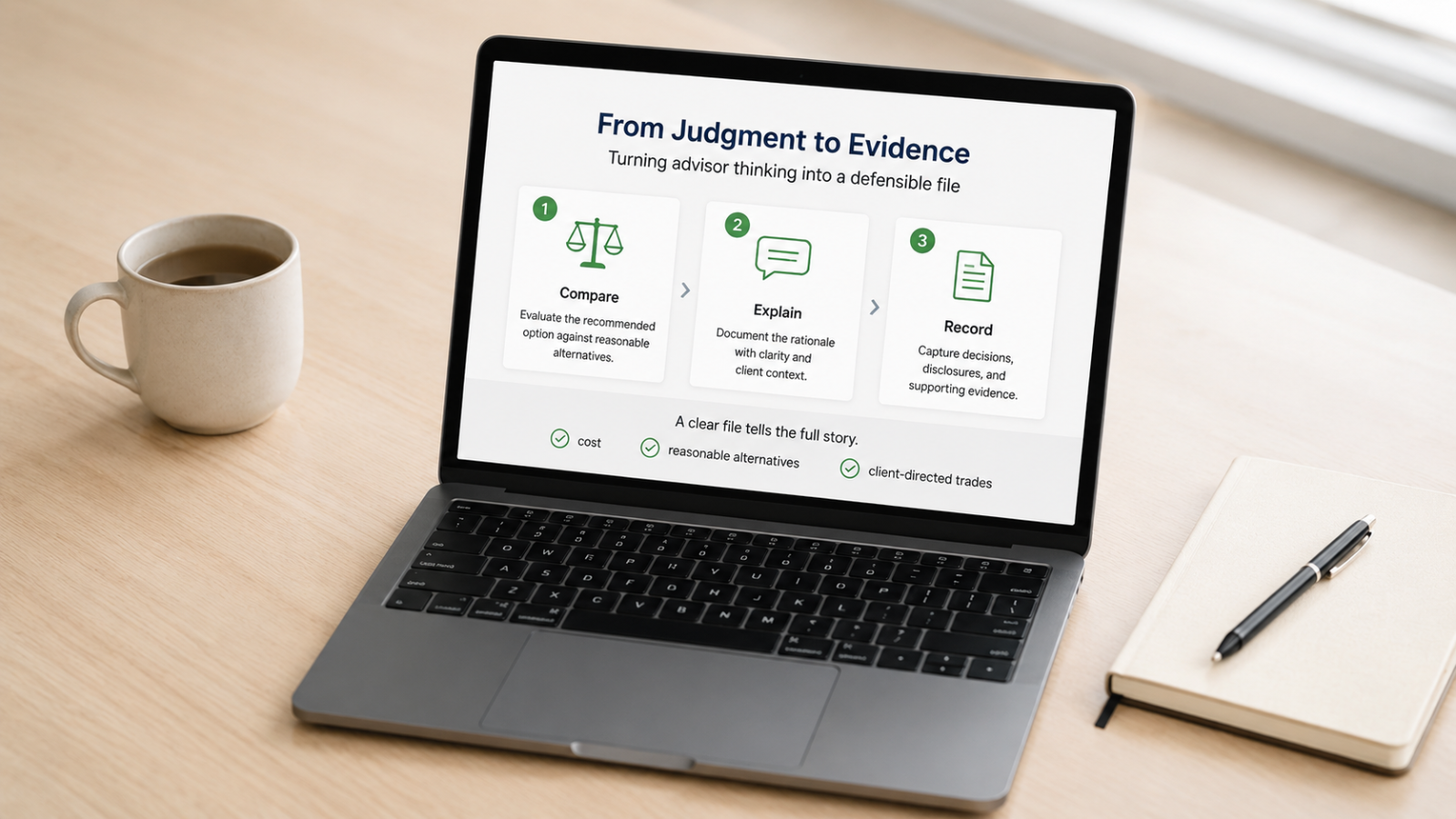
The Documentation Gap: Cost, Alternatives and the Evidence Problem
The file usually fails on proof, not intention.
When KYC Breaks Suitability
Suitability problems often look like product problems. Sometimes they are. But often the weakness began earlier, in the client file.
After Approval: The Quiet Work of Ongoing KYP Monitoring
The most dangerous moment in a KYP process may be the moment everyone feels finished.